Chapter 5:
Services to the Community
Executive Summary
Services on Palm Island must function within the constraints of a bridgeless barrier island, where limited access, fragile infrastructure, and environmental sensitivity shape every aspect of emergency response, hurricane preparedness, and daily operations. Community input across surveys, written comments, and two days of public workshops revealed strong alignment on the need for reliable Fire/EMS services, clearer emergency communication, and practical improvements that enhance safety without compromising the Island’s low‑impact character.
Residents expressed strong support for improving address visibility, ensuring functional fire hydrants, and clarifying fire flow capacity — issues that directly affect emergency response times. Many raised concerns about narrow roads, vegetation overgrowth, and limited turnarounds that restrict access for fire trucks and ambulances. The fairness of the Fire/EMS MSBU funding model was also a recurring theme, particularly when Station 10 resources are deployed off‑Island. Community participants emphasized the need for more visible law enforcement presence during peak periods and better coordination between Dispatch, Palm Island Transit, and Charlotte County during emergencies.
Hurricane evacuation and disaster planning generated significant discussion. Residents supported early evacuation but expressed frustration with inconsistent or unclear ferry operations during storms. Although communication has improved, many emphasized the need for a unified, reliable information channel. Generator safety, boil‑water advisories, and post‑storm re‑entry procedures were also identified as areas needing better guidance.
Opinions regarding other essential services such as waste management, mosquito control, signage, and potential mail delivery reflected the community’s desire to maintain the Island’s aesthetic while improving day‑to‑day operations. Residents supported continued mosquito control and better education about waste disposal and dumping rules. There was strong concern about excessive signage in public rights‑of‑way, with broad support for reducing visual clutter while preserving the Island’s distinctive hand‑painted signs. Opinions on mail services were mixed, with many preferring to avoid additional traffic and mailbox infrastructure.
Across all service categories, residents favored practical, education‑first solutions that improve safety, communication, and operational resilience while preserving the Island’s quiet, low‑density character. This chapter provides a framework for strengthening essential services in a way that reflects the community’s values and the unique conditions of Island life.
5.0 Introduction
As a bridgeless barrier island, Palm Island relies on a unique combination of local, county, and private services to ensure safety, emergency response, hurricane preparedness, and daily operations. Limited access, constrained infrastructure, and environmental sensitivity require service models that are reliable, resilient, and tailored to Island conditions. This chapter outlines the community’s priorities for Fire/EMS, hurricane evacuation, and essential municipal services, emphasizing practical improvements, clear communication, and stewardship of the Island’s character.
5.1 Fire and Emergency Medical Services
Fire and EMS services on the Island are provided by Charlotte County Fire‑EMS through Station 10, funded exclusively by Island property owners via the Barrier Islands Fire Service MSBU. Station 10 is staffed 24/7 and serves as the primary responder due to the time required for mainland units to reach the Island by ferry. Backup procedures include coordinated dispatch, nighttime ferry activation, and helicopter evacuation when necessary.
Water supply for firefighting is provided by two private utilities, with hydrants fed by Englewood Water District. Fire flow capacity remains uncertain, and hydrant testing responsibilities are unclear. Narrow roads, limited turnarounds, vegetation overgrowth, and increasing development along the beachfront complicate emergency access. As the Island builds out, helicopter landing zones and beach access routes may become more constrained.
Community Input
Property owners strongly supported improving address visibility, ensuring hydrants are functional, and clarifying fire flow capacity. Many expressed concern about inconsistent or unclear hydrant testing responsibilities and the fairness of the MSBU funding model, especially when Station 10 resources are used off‑Island. Community participants emphasized the continuing need for emergency vehicle access.
Issues
- Inconsistent or unclear house numbering makes it difficult for responders to locate properties.
- Renters may not know their address or which island they are on when calling 911.
- Narrow roads, vegetation overgrowth, and limited turnarounds could restrict emergency vehicle access.
- Helicopter landing zones may become limited as development increases.
- Hydrant fire flow capacity is unknown, and testing responsibilities are unclear.
- The MSBU funding model may be inequitable if Station 10 resources are used for mainland emergencies.
- Residents perceive the MSBU tax burden as high and worry about future increases.
Recommendations
- Encourage clearly visible, reflective house numbers on all properties.
- Rental properties should display the address prominently within each unit for 911 identification.
- Continue to improve vegetation management and road access to support emergency vehicle movement.
- Preserve and monitor beach access points for emergency use.
- Ensure helicopter landing zones remain available as development increases.
- Request Charlotte County to test hydrants, confirm fire flow capacity, and clarify maintenance responsibilities.
- Explore transitioning Station 10 from an MSBU‑funded unit to full integration within Charlotte County Fire‑EMS.
- Monitor the Fire/EMS budget to ensure equitable MSBU assessments.
- Promote resident participation in the Red Dot and Knox‑Box programs.
- Continue educating residents and visitors on emergency procedures and 911 protocols.
5.2 Hurricane Evacuation and Disaster Planning
Hurricane evacuation on the Islands is governed by Charlotte County Emergency Management (CCEM), with Palm Island Transit (PIT) providing the only vehicular route off the Island. Ferry operations depend on weather conditions and may cease before the scheduled cutoff if winds become unsafe. Re‑entry is controlled by CCEM and may be delayed until conditions are safe and emergency services can return.
Residents must rely on personal preparedness, early evacuation, and accurate communication. Long‑term power outages, generator safety, boil‑water notices, and limited access points create additional challenges during and after storms.
Community Input
Residents support early evacuation and emphasized the need for clearer, more consistent communication about ferry operations and emergency procedures. Many expressed frustration with perceived inconsistencies in ferry access decisions and the lack of a unified communication channel. Participants also highlighted the need for better generator safety awareness and improved communication from water utilities during boil‑water advisories.
Issues
- Inconsistent or unclear communication about ferry operations during emergencies.
- Not all residents are enrolled in emergency alert systems.
- Increasing year‑round population may complicate future evacuations.
- Ferry operations may cease earlier than expected due to weather conditions.
- Re‑entry delays cause anxiety for property owners seeking to assess damage.
- Unsafe generator use during power outages poses risks.
- Boil‑water notices may not reach all residents promptly.
Recommendations
- Encourage all property owners to sign up for AlertCharlotte for official emergency notifications.
- Improve communication between PIT, CCEM, and residents regarding ferry operations.
- Promote early evacuation and personal preparedness.
- Request improved communication from water utilities regarding boil‑water advisories.
- Educate residents on generator safety and post‑storm hazards.
- Reinforce that emergency services will not be available during severe storms.
5.3 Other Services for the Island
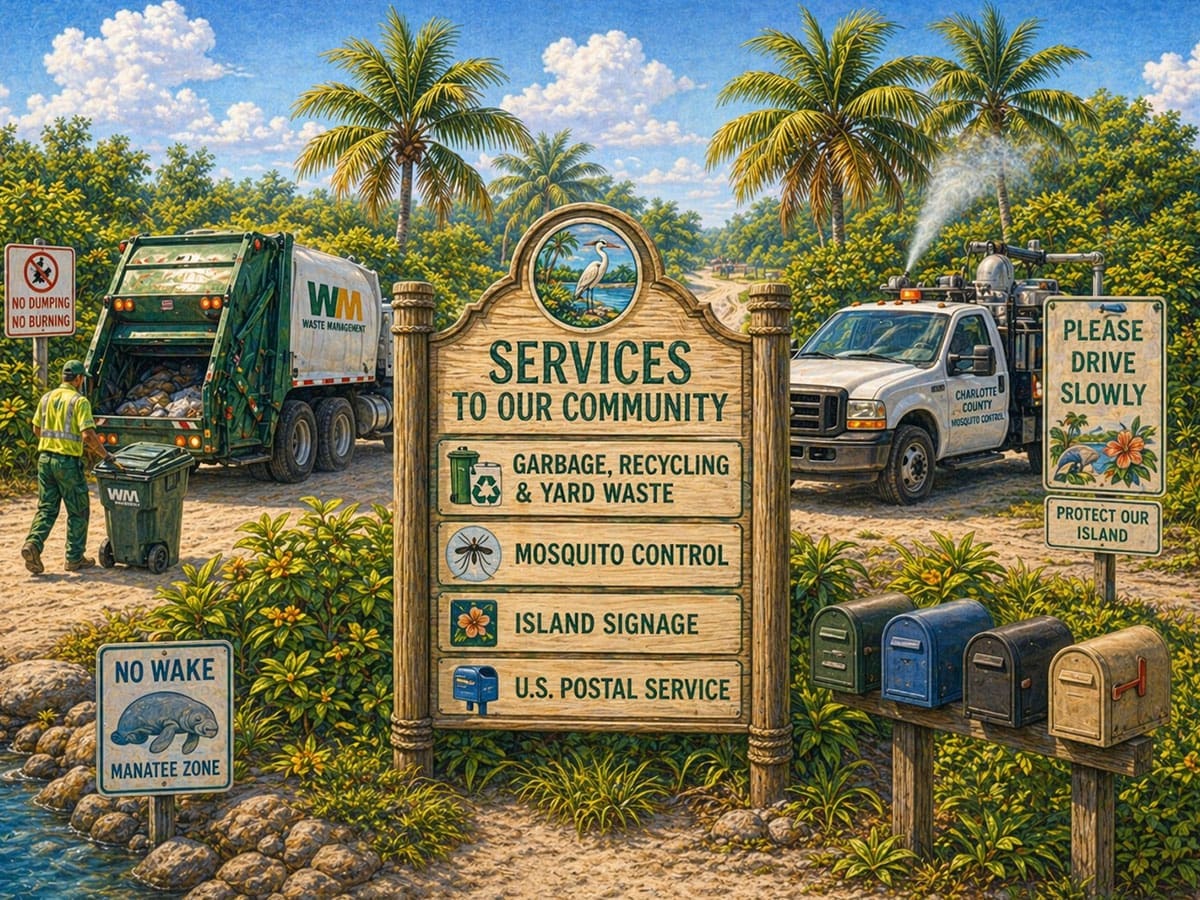
Island services include solid waste removal, mosquito control, signage management, and discussions about potential mail delivery. Waste Management provides garbage, recycling, and yard debris pickup through an MSBU. Mosquito control is provided by Charlotte County on an as‑needed basis. Islanders value the Island’s artistic, hand‑painted signs and express concern about visual clutter from commercial and government signage. Mail delivery remains a mixed topic, with concerns about traffic, infrastructure, and aesthetics.
Community Input
Residents support continued mosquito control and identified the need for better education about waste disposal and dumping rules. There was strong concern about excessive signage including commercial, governmental and non-profit signs placed in public rights‑of‑way. Opinions on mail service were mixed, with many preferring to avoid additional traffic and mailbox clutter. Residents favored maintaining the Island’s unique aesthetic and reducing visual pollution.
Issues
- Overfilled or unsealed garbage cans attract pests.
- Yard debris dumped on vacant lots creates fire hazards and visual blight.
- Some residents are unaware that vacant lots do not receive waste pickup.
- Illegal dumping and burning occur on vacant lots.
- Many residents do not know they can request mosquito control service.
- Hand‑painted signs require maintenance.
- Excessive signage creates visual clutter.
- Lack of canal signage for No Wake and Manatee Zones.
- Mail delivery could increase traffic and infrastructure impacts.
Recommendations
- Publicize no‑burn and no‑dumping regulations.
- Promote the proper sealing and timely retrieval of waste receptacles.
- Encourage property owners to request additional receptacles if there is overflow.
- Continue mosquito control services and pursue the use of environmentally-friendly aerosol sprays for treating adult mosquitoes.
- Encourage residents to request mosquito treatment when needed.
- Maintain existing hand‑painted signs and explore reducing overall signage impact.
- Work with Public Works to design government signage that complements Island aesthetics.
- Discourage lighted signs to protect dark skies.
- Improve canal signage for No Wake and Manatee Zones.
- Continue evaluating mail service options while considering traffic and aesthetic impacts.
5.4 List of Community Priorities
- Improve emergency access through better addressing, vegetation management, and maintained beach access.
- Ensure hydrant functionality, fire flow capacity, and a clear determination of maintenance responsibility.
- Strengthen communication during emergencies, especially regarding ferry operations.
- Promote early evacuation and personal preparedness.
- Support mosquito control, waste management education, and enforcement of dumping rules.
- Reduce visual clutter by limiting signage.
- Maintain the Island’s aesthetic through artistic signage and dark‑sky practices.
- Ensure equitable and transparent funding for Fire/EMS services.
- Preserve the Island’s character while maintaining and adapting community services as the Islands approach build out.
5.5 Overall Conclusions
Island property owners consistently emphasized safety, communication, and preservation of the Island’s character. They support practical improvements — such as better addressing, strategic signage, hydrant testing, and clearer emergency communication — while resisting changes that would increase visual clutter or alter the Island’s low‑impact identity. Across all services, the community favors education, transparency, and collaborative problem‑solving. This chapter provides a framework for strengthening essential services while maintaining the unique qualities that define Island life.