Chapter 4.1
Infrastructure – Transportation to and from the Island
On this page, there are three key elements:
- Summary
- Full text for this section of the Neighborhood Plan
- Short survey
Summary:
Living on the island means you either rely on the ferry or your own boat.
If you commute by boat, you’ll need a mainland dock and a place to park your vehicle. Dock permitting isn’t always applied consistently, and keeping canals and lagoons navigable is critical for access.
If you want to bring a vehicle to the island, the only option is the Palm Island Transit ferry. Because it’s privately operated, there are no long-term guarantees around service, cost, or reliability. Traffic congestion can lead to long wait times, and parking is already limited on both the mainland and island sides.
We recommend:
- Planning ahead for possible ferry interruptions
- Identifying and secure additional parking options before capacity becomes a bigger issue
- Improving traffic flow near the ferry to reduce congestion
- Exploring a program to help property owners access the island after storms
Full Version:
We encourage everyone to read the full version. While we did our best to summarize above, this full version offers much more nuance.
Infrastructure and development are closely linked, with growth typically requiring greater access and capacity. A key goal of this plan is to create an infrastructure approach that aligns with the Island’s existing and desired build-out. This is challenging because the standard solutions are not in accord with the Island’s character, and the enforcement of existing regulations is difficult.
4.1 Transportation to and from the Island
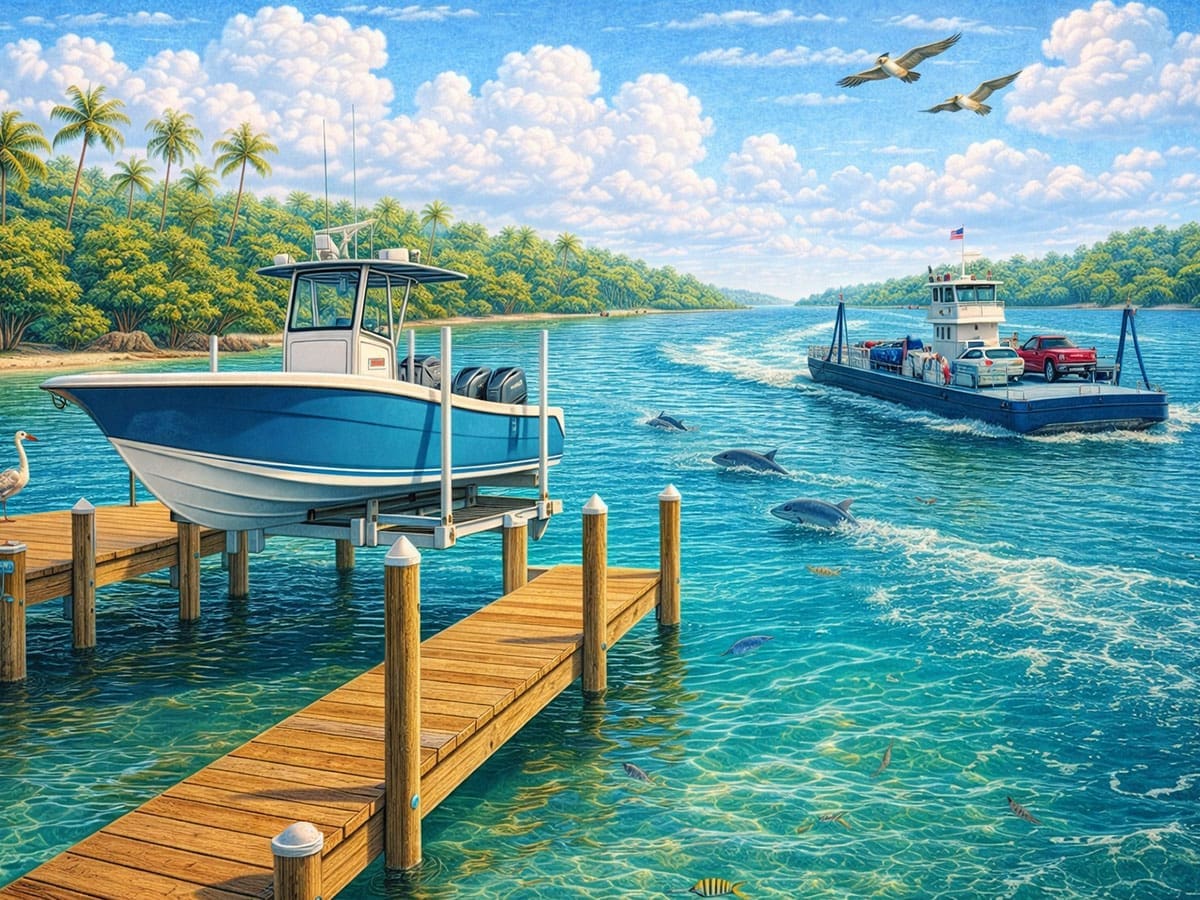
The Island is a bridgeless island community which is accessed from the mainland exclusively by ferry or personally owned boat. Residents value the seclusion, which preserves the Island’s unique character and quality of life; helicopters are limited to emergencies only.
- Personally owned boats.
Most Island homes are waterfront and connected by canals and lagoons, but some homes are landlocked and lack docks. Owners who commute by personally owned boat must arrange for their own mainland dockage, typically by owning a dock lot or leasing a slip. - Existing Ferry Service.
Vehicle access to the Island is currently provided exclusively by the privately operated Palm Island Transit ferry, which carries vehicles, equipment, emergency services, golf carts, and pedestrians. A separate water taxi serves the Rum Bay Restaurant. The ferry usually operates from 6:30 AM to 10:00 PM daily with later closing hours on weekends, generally runs two vessels simultaneously on weekdays until 5:00 PM, charges $55 per car (with discounted passes available), and suspends service during severe weather or when sustained winds reach 40 mph. The ferry is open to the public and is a defining element of the Island’s character. - Alternative Ferry Service.
Since the 1980’s ferry service has been privately held, raising concerns about the lack of competition. Suggestions have included municipal, private or cooperative ownership of an alternative ferry, however, a viable plan has not yet been proposed. Challenges to an alternative ferry service initiative include finding an appropriate on-island landing site that could accommodate parking, stacking and dockage as well as environmental, zoning and land use concerns. - Parking at the Ferry Landings.
Many residents drive directly to their Island homes from the ferry, while Palm Island Resort residents use a dedicated parking lot at the Resort. Others park near the ferry and walk on, using public parking along Panama Blvd. under an agreement with Charlotte County. Additionally, there is a private co-op parking lot on Panama Blvd. with spaces available for a fee. Overnight roadside parking on the Island is permitted but “No Parking” zones on Panama Blvd. are enforced.
Issues related to Transportation to and from the Island
- It is a primary concern for boat owners that that the permitting process for the building or repair of docks is consistently applied to all lots.
- It is important that the canals and lagoons are navigable to insure access by water to water-front property.
- Speeding and safe boating in the canals is an issue, including the continued support for and enforcement of “No Wake” zones for both navigational precaution and the protection of manatee and dolphin habitat.
- Islanders also wish to preserve the waterways as clean and available infrastructure, supporting the mangroves and the habitats they contain.
- All homeowners that choose to commute by personally owned boat will need to secure a dock and vehicle parking on the mainland.
- The ferry is the Island’s sole vehicle access, but as a privately-operated service it provides no long-term guarantees regarding continuity, cost, or service levels.
- Current ferry operations rely on leased island property and county parking agreements that may not be sustainable over time.
- Ferry-related congestion is already evident during peak seasons and normal workday transition times and is worsened by periodic ferry maintenance and post-storm reconstruction demands.
- Expanding to 24-hour service is not considered a practical solution due to high cost, operational difficulty, and limited off-peak demand.
- The existing parking on Panama Blvd. is strained by the present volume of traffic from Island residents, visitors and construction workers. As we move toward higher levels of population on the Island, we recognize that public parking along Panama Blvd. on the mainland may become inadequate.
- The mainland parking lot may be at capacity long before we reach maximum build out. Alternatives need to be explored and preparations made before the issue becomes a time-sensitive problem.
Recommendations related to Transportation to and from the Island
- Island property owners must consider the fact that the private ferry service available to them is a convenience, not an entitlement. Part of that consideration should be the planning for contingency should ferry service be interrupted, restricted or discontinued for any reason. Prospective buyers should be aware of the “deliberate inconvenience” of living on a bridgeless barrier island.
- Increase awareness regarding diminishing mainland docking/parking spaces and marina spaces.
- Explore a re-design of Panama Blvd. to accommodate a through-lane for continuous movement of traffic and a discreet lane for stacking traffic waiting for the ferry among other ideas for efficient use of space to solve the traffic problem.
- Investigate possibility of a program using residential parking stickers to facilitate post-storm access for property owners by reserving parking areas on the mainland side or identifying resident for post-disaster access.
Survey
Each head of household (up to two per household) may submit the form once. If you submit it more than once, only your most recent submission will count. This also means you can update your response later if you change your mind.