Chapter 4.3
Infrastructure – Water and Wastewater
On this page, there are three key elements:
- Summary
- Full text for this section of the Neighborhood Plan
- Short survey
Summary:
The Island is more than halfway built out, with capacity for about 1,125 homes.
Water
Most homes get water from two private utilities supplied by Englewood Water District. Islanders are concerned about the high cost of water and whether there will be enough water in the future.
Wastewater
Island residents want a safe, affordable wastewater solution that protects the environment and fits the Island’s needs, without relying on a central sewer system.
We recommend:
- Protect and conserve water by encouraging low-water landscaping, limiting irrigation, and reducing strain on wells.
- Make sure the Island has a reliable long-term water supply, including exploring better utility options if needed.
- Do not install a central sewer system, and instead support safer, modern septic alternatives.
- Improve and monitor septic systems and water quality to better protect the environment.
Full Version:
We encourage everyone to read the full version. While we did our best to summarize above, this full version offers much more nuance.
According to the County, the Island has a potential 1,125 households at build out condition. Fewer than half of the existing households have full-time residents at this point, with the majority having seasonal occupants.
It has been estimated by the Charlotte County Community Development Department that the Island is presently more than 50% built out. Many residents have expressed concern about the future of the Island environment, specifically the wastewater treatment and the concern of water depletion in the aquifer.
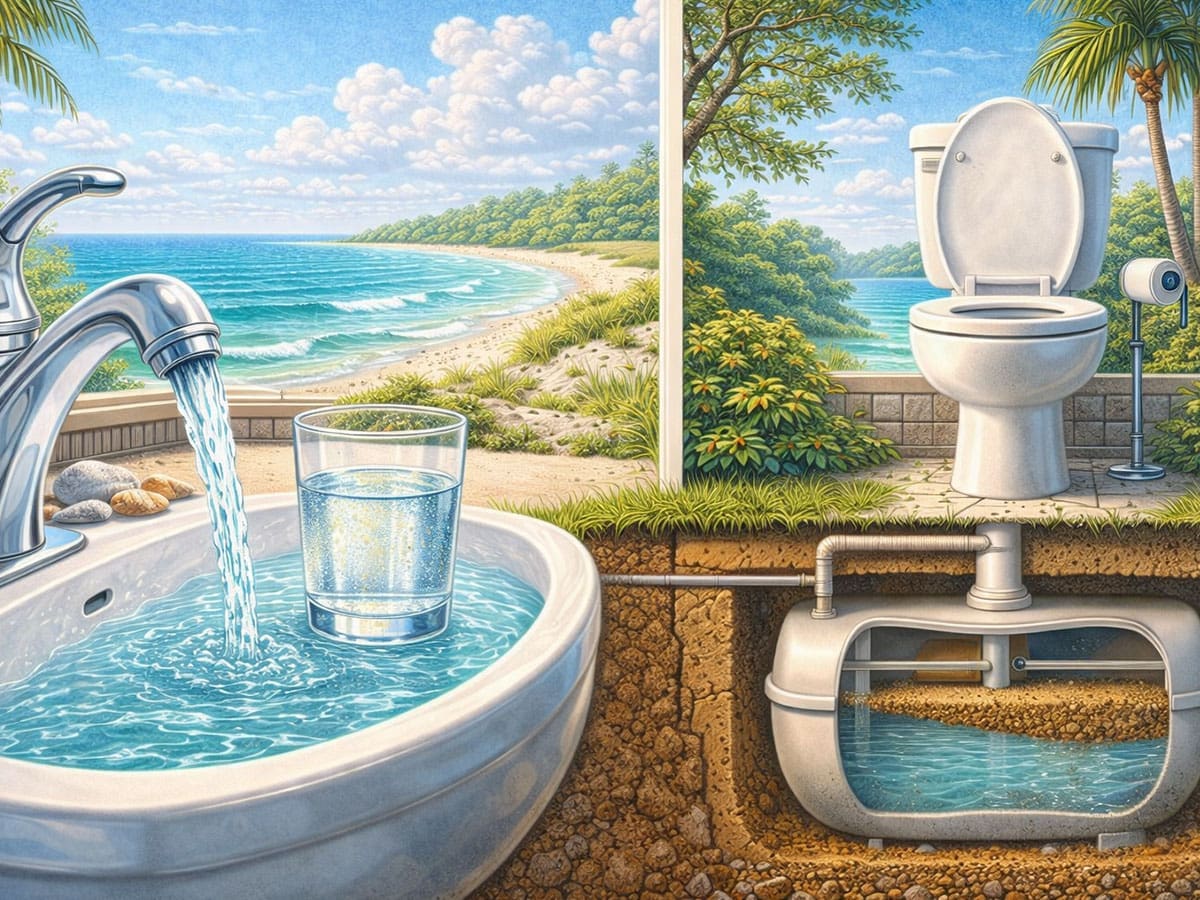
Water Approach. Most Island residents are served by one of two privately-owned utilities providing central water, Knight Island Utilities, Inc. (KIU) and Bocilla Utilities, Inc. (BU) KIU serves the Palm Island Resort and some developments north of the Resort. BU serves a territory which extends south of the Palm Island Resort to the Don Pedro Island State Park. These two utilities distribute water that is outsourced from Englewood Water District. A few homes on the Island use private wells and cisterns as their potable water source. Some households use wells and cisterns for landscape irrigation.
Wastewater Approach. Island residents prioritize environmental protection. While a long-term wastewater solution is needed, central sewer—favored by the County—would require mandatory hook-up once available at a substantial cost to homeowners and poses a severe risk of sewer spills.
Central sewer also raises concerns about increased density and unwanted development, despite existing overlay limits that could be altered through variances or plan amendments. The community seeks a solution that could accommodate full build-out without environmental harm.
The State currently recommends “Enhanced Nitrogen-Reducing On-site Sewerage Treatment and Disposal Systems” (ENR-OSTDS) as a wastewater removal equivalent to central sewer. These systems represent the most advanced technology in alternative waste management and resolve environmental concerns while eliminating other issues with central sewer.
Issues related to Water Approach and Wastewater Approach
- The high cost of water provided by the current utilities relative to other utilities in the County and the State.
- Islanders share the same concerns as all Charlotte County residents about the future availability of water.
- The following issues have been raised relative to wastewater removal and treatment:
- Identifying and promoting a wastewater removal system that is the least fallible and most protective of the environment.
- Reducing or subsidizing the costs associated with installing alternative wastewater removal systems.
- Factoring usage intensity into decision-making, including seasonal over-usage versus non-season under-usage.
- Assessing whether existing technologies could provide environmental improvements to the septic systems currently in place.
- While the County prefers central sewer installation on the Island, the vast majority of Island property owners do not want it.
Recommendations related to Water Approach and Wastewater Approach
- Proactively seek out ways to protect and preserve water resources. This will include working with Bocilla Islands Conservancy, Inc. (BICI) to promote Florida friendly, low or no irrigation landscaping, discourage the use of wells for landscape irrigation, evaluate landscape watering restrictions and identify effective strategies to conserve water.
- Maintain permeable, porous roadways to alleviate the potential further degradation of the aquifer.
- Explore whether County-operated utilities are an option to provide potable water service to the Island.
- Ensure that the community’s potential future water needs have been factored into the County’s plans for potable water provision if local utilities cannot meet the Island’s needs.
- Exclude the installation of island-wide central sewer as an option for wastewater removal and treatment.
- Support the State recommendation for the installation of the ENR-OSTDS systems in new or replacement construction on the Island.
- Support the OSTDS septic monitoring system implemented by the County to evaluate the efficiency of existing septic systems.
- Explore ways to promote proper maintenance and preventive care for older septic systems.
- Support the County’s water quality testing program which monitors water quality degradation attributable to contaminants and pollutants.
- Prepare a thorough, updated cost analysis of the alternatives available for advanced wastewater removal and treatment.
- Ensure that the time framework associated with the implementation of an advanced wastewater solution will allow for its institution well in advance of unacceptable degradation of the Island canals, beaches and ground water.
- If it is determined in the future that an alternative wastewater system needs to be established, ensure that the implementation of that system does not create potential opportunity for additional commercial use or increased density on the Island.
Survey
Each head of household (up to two per household) may submit the form once. If you submit it more than once, only your most recent submission will count. This also means you can update your response later if you change your mind.